Reviews

Album review: Avatar – Don’t Go In The Forest
Swedish metal jesters Avatar hit double figures in macabre, OTT style on raucous new album.
Skulls. Facepaint. Outlandish outfits. A touch of magic and macabre. Mexico’s Día de Muertos feels like the spiritual home of Avatar, who’ve spent a quarter of a century bringing their carnival of delights to life. To find out how these colourful worlds intertwine, we head south of the border to meet a band ready to take their next leap into the great unknown...
It’s not often that Johannes Eckerström can blend into a crowd while wearing his work uniform. Standing at six-foot-four in his socks, as Kerrang! keeps up with him as he shuffles through the rammed streets of Mexico City, the top of his head might be easy enough to pick out, but the Avatar frontman’s harlequin-painted face? Not a second look, either here or in the lobby of his hotel.
“This is like the opposite of normal,” he grins. “Normally I’d look like a total freak walking down the street. Here I’m probably not even the weirdest-looking guy on this block!”
K! is joining Johannes at Día de Muertos, the Mexican Day Of The Dead. The annual carnival to honour and remember the departed every November on the Catholic All Saints Day and All Souls Day is a rainbow-coloured do that brings out a macabre strain of joy across the city.
With its skeletal floats, ever-present skull motifs and beautiful, intricate facepainting on everyone from kids to city officials, partying alongside plague doctors, demonic dancers and, frankly, monsters, the dead are very well represented. But Día de Muertos is a far from morbid affair. Amid the vibrant noise of the parades and street shows, colourful ofrenda altars honouring the departed are laden with personal items to make them feel welcome and at home – favourite things, drinks, photos – are a feature everywhere you go.
“It seems like a very healthy way to keep people alive,” says Johannes, as a giant, top-hatted skeleton smoking an enormous cigar shimmys past. “In the process of mourning, of course there has to be the pain and sorrow and sadness and loss, and there’s no other way to make it through it, but you also need to think, ‘How we can keep people alive and keep on loving someone who’s no longer here?’ I feel like this culture does that very well.”
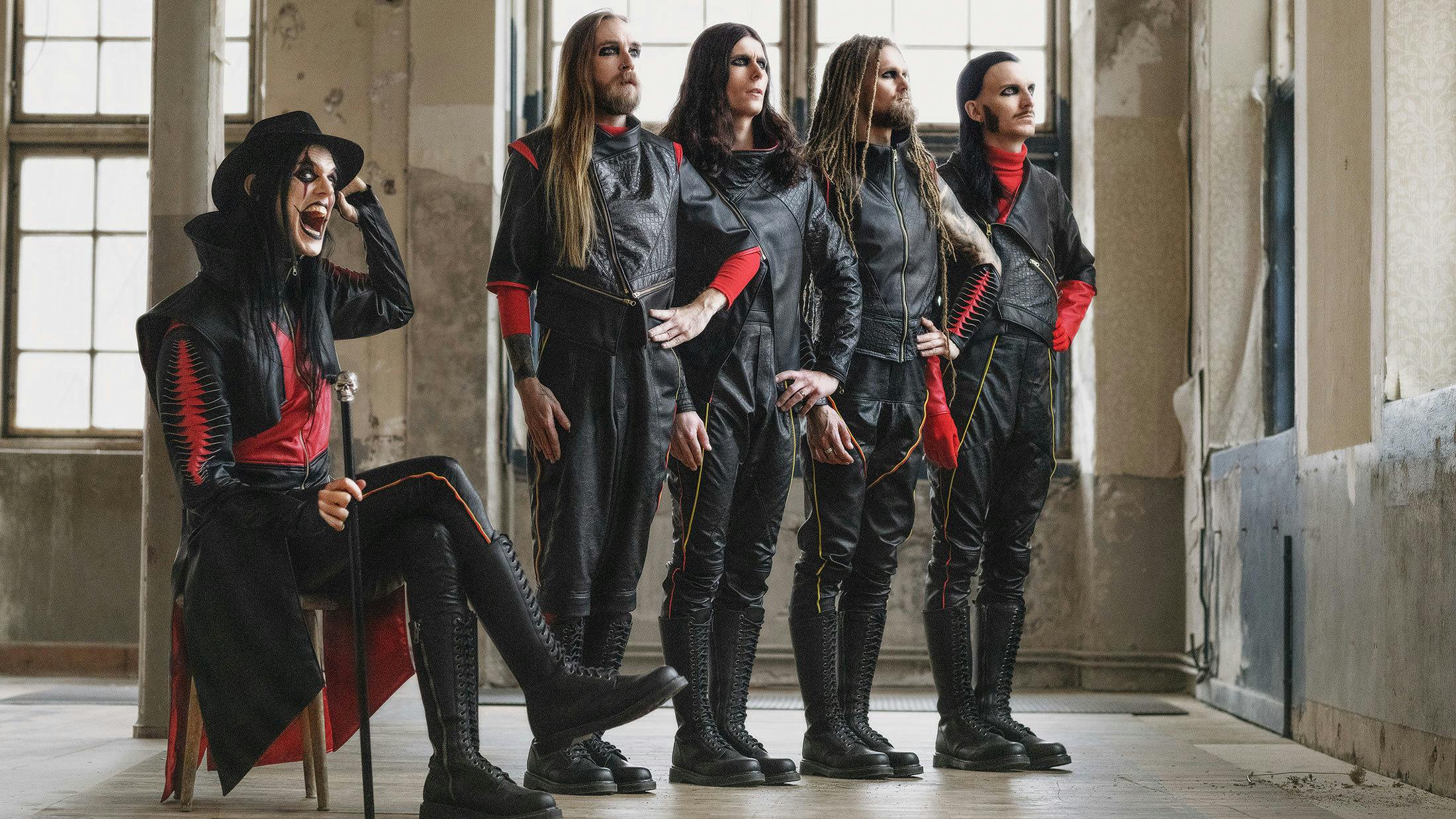
There’s another reason a sizeable number of Mexico City’s residents have their facepaint on. On Halloween, the night before Día de Muertos kicks off proper, Avatar opened their latest chapter. In the corridor outside their dressing room, the promoter had thoughtfully laid out an ofrenda in their honour, despite the band – Johannes, guitarists Jonas Jarlsby and Tim Öhrström, bassist Henrik Sandelin and drummer John Alfredsson – being very much alive.
It is, however, still cause for celebration. Three, actually. Most importantly, it marks the release of Avatar’s latest album Don’t Go In The Forest. Even here, there’s an appropriate touch of death.
“Release has a double meaning there, because it also means letting go,” Johannes says. “Of course, as a performer and musician, you live with your music forever, but as a writer it’s done. I couldn’t change anything three months ago either, but once it’s out, you reach the point of the death of the artist, death of the author, and it belongs to everybody now.”
Second celebration: this is the Swedes’ first headline show in ages (discounting the small matters of a summer at massive festivals and playing stadia with Iron Maiden), firing the starting pistol on a huge world tour of their own. And, finally, as a cherry on top, the 8,000 people going nuts in Mexico City’s Pepsi Center are constituents at Avatar’s biggest gig to date.
“It’s nice to do something special on the day of release, because release days can be weird. When you make a record, it becomes very personal to you in terms of what it means in your own life and the energy you put into it. And then you put it out, and you see some reactions, but also the Earth keeps spinning. So, to have 8,000 people there with you on that special day, making it real, is amazing. The fans here are crazy as well. And there was an Avatar cake to celebrate afterwards.
“It’s all downhill from here!”
The following day, as the streets fill with festive skeletons – and, in a few cases, masked kids wielding chainsaws – Johannes prepares to head out into the madness.
“Normally, people would be like, ‘What the fuck is this?’” he grins, beneath the ever-smiling make-up. “But this is like going out in Hollywood or Times Square, where everyone looks weird, or they’re Spider-Man or something.”
Seeing him both with and without his grinning Avatar face on, Nordically chiselled and good looking as he is without the slap on, he also has that same effect as The League Of Gentlemen’s Papa Lazarou – that at this point, what you see onstage is actually his real face, so naturally does he wear it.
Though he says that the make-up doesn’t really change him, that it’s just an extension of what he’s trying to express and that his onstage persona – the larger-than-life personality, the jestering, the twisted humour – is always there, the impression is still very different to the man who’ll later spend the evening munching vegan tacos in civvies.
Like Día de Muertos, there’s much beneath the initial exterior of Johannes and Avatar.
“Metal can be very dark and very aggressive, it can sound evil and brutal, and if you aren’t into it, it can seem totally dark if you’re experiencing it for the first time,” he ponders. “But for people like us, people who live with the music, all that stuff is part of it, and the music actually becomes very uplifting. It’s exciting and empowering.
“It’s bizarre when you think about it. You go to see Metallica, and it’s in some huge stadium, you’re with your friends, and you’ve got one of those cardboard things that holds five beers at once. But then they play One, and you’re going crazy to it, while also completely understanding that it’s about a guy with no arms, no legs, stuck in a bed and he wants to die.
“Other genres,” he chuckles wryly, “are usually not like this.”
Don’t Go In The Forest is, in part, a reflection of all this. Just as there’s the pull to really reflect on mortality in the weekend’s celebrations, where polite society might suggest that such things don’t make for particularly proper dinner conversation, it’s the idea of warning piquing your curiosity. Go where you will.
“That’s the whole point of the title,” nods Johannes sagely. “That little metal kid, the little weirdo who got into this music, that’s like me. If someone said to me: ‘Don’t go in the forest,’ man, I’m totally going into the forest!”
During our slow shuffle through Mexico City to get to the enormous Zócalo in the historical district, and the hub of the celebrations, among the fans who do realise that Johannes is Johannes, are a pair dressed as Pennywise and Georgie from IT. The latter has the inaccuracy of a full complement of arms, but also the dynamite prop of a red balloon, enabling Johannes to recreate the cover stance from the album, thousands of miles and a good few degrees on the thermometer away from the Scandinavian wilderness in which it was conceived. Once again it’s about, in some ways, being drawn to the darkness.
“There’s something about when you are out in the woods at night, when you’re using flashlights in the dark and there’s that electronic illumination of nature, the darkness around you feels vast,” he explains. “We had that idea in mind for photos and video, and there’s a bunch of stuff of me at night on the hood of a car. But then we got into driving at night, out in the forests, and the creepy thought of turning a corner and seeing me in the road there. That’s basically a horror film! Imagine seeing me come out of nowhere with my balloon – you’re shitting bricks!”
Johannes’ own musical journey to the dark side began as a kid. From a young age he’d been learning piano, then trombone. During a trip away with his family in which he had a tape Walkman (“A cheap price for my dad to get a few hours of peace in the car”), his older brother turned him on to the sound of German power metal kings Helloween and their Keeper Of The Seven Keys: Part II opus.
“After that was the natural journey to the extreme music with similar things, but darker,” he describes. “I remember visualising the atmosphere of death and black metal bands.”
And the piano lessons had put Johannes in good stead for having a go at making his own music.
“Around the age of eight, I started to play a lot with a classmate of mine, and he had this kind of MIDI sequencing program on his computer, but using notes from sheet music, which I could read. We would together come up with music on that between playing with LEGO or Mighty Max or whatever.”
In eighth grade, he began playing in a band with friends who would become Avatar, doing covers of Metallica and Ozzy Osbourne songs. Johannes was, he says, “tricked” into becoming a singer, a role thrust upon him because he was “slightly less shy than the other guys”. Eventually, their repertoire grew to encompass Helloween and Slayer (“The two basic elements of what we do right there”). Their own material came up when a local battle of the bands stipulated that all entrants had to perform at least one original song.
“Jonas wrote some riffs, stacked them in a row, I wrote some lyrics, and we had our first song,” he recalls. “It wasn’t good, but we realised, ‘I guess we’re writing songs now.’”
The following attempt also wasn’t very good, according to the author. The next couple were “shitty”, too, but showed signs of improvement. Pretty soon, they hit on what became War Song, which would eventually end up on their Thoughts Of No Tomorrow debut album in 2006.
At the time, the make-up wasn’t in the picture. That came in 2012, around fourth album Black Waltz. Having done it for the title-track’s video, and appeared on the album cover dolled-up, it became a bit onstage during a show opening for Hardcore Superstar.
“For a few seconds in the beginning, I thought people were laughing at me. I had a moment feeling really self-conscious where I thought, ‘Oh no. I’m a fucking clown.’ But then I realised, like, ‘I am a fucking clown.’ The whole thing felt right, it clicked, and fell into place.
“This huge thought process and transitional moment of my life, it took seconds. But there was that brief second of complete self-consciousness, like the dream where you show up to school without clothes. But once I was past that, I knew everyone was with me.”
It’s not, however, a mask. The difference is, Johannes says, it’s his real face, he’s still making expressions and sticking his tongue out and doing things with his own fizzog. But it did give a symbol, a mascot, around which a lot of other stuff could orbit and, as the Avatar world grew, make sense.
“There are so many parts to us. There’s something like Avatar Country, the comedian side, then right after was Hunter Gatherer, the deadly serious side. The frame can always be adjusted to fit all those things. The whole clown thing is because I am a clown, that’s why it works. It’s not a stage name, it’s not playing a character. It’s just an opportunity for me to express myself more freely than I could in another profession.”
Indeed, onstage at the Pepsi Center, Johannes is quite the performer. With a similar style to Bowie, or Creeper’s William Von Ghould, he’s a man who often performs from his hips, wearing his hats and leather trousers and long PVC gloves as an entry point into his wicked world. He uses his big, flamboyant personality to marshal 8,000 people, charming, rather than yelling macho demands at them. It is, we say, a very fabulous way of doing a gig.
“Fabulous is a definitely a word!” he laughs. “That’s what I aspire to do. I certainly have that in me, always. But it would be quite obnoxious to always be in that mindset, right? But there’s even home videos of me when I was, like, five, six years old, singing with my siblings. In hindsight, at least to me, the line from there to what I do now looks pretty straight!”
Is there a difference between this you – the Avatar Johannes – and the guy without the make-up?
“I mean, there’s more to me, like any other person. But you don’t see that. People say, ‘Oh, it’s crazy how he’s like that onstage, and then he’s so shy and reserved outside of that.’ But that’s not true either.
“There’s definitely the guy who I show up as publicly at shows, but in between there are dinner parties, karaoke nights, playing with kids, being with my dogs, you know, and they’re all the different steps in between.”
Either way, Johannes’ leering, made-up face on album covers and posters and shirts does make him quite literally the avatar of Avatar. This, he says, definitely makes it less weird to think of someone getting his face tattooed on them, because it’s like a symbol, in some sense.
“I remember the first time I saw someone got my face tattooed on their body. I realised the facepaint works as this thing. It’s more than me. As long as it’s me all dressed up, it feels good. If we were Iron Maiden, my job would be Bruce Dickinson, the singer, and Eddie the symbol.”
Avatar’s time with Maiden in summer 2025 was a dream gig, and a learning curve. It challenged Johannes, in the way of all support gigs, to turn someone else’s audience into your audience. It also gave the band time to reflect on their own journey. One night, when Johannes’ brother and his son came to see them, the magnitude of everything hit home when, showing his guests around backstage, he pointed out Bruce Dickinson’s Trooper flag, and his brother couldn’t believe what he was seeing.
“That was a moment, like, ‘Thank you for reminding me where we are.’ Because sometimes when you’re in the middle of these things, you’re so focussed on your own show, dream things like that become normal. And it’s really not!”
This summer, he’ll have a similar thing when Avatar hit stadia with Metallica. As “a big pro-wrestling fan”, Johannes says The Four Horsemen’s in-the-round Snakepit stage shouldn’t present any problem, although he is acutely aware that “at any point, a huge number of people are gonna just be seeing my ass!”
That, though, is for the future. Avatar’s current focus is on entering into their biggest era to date under their own steam. While we’re part of the festivities in Mexico City, the rest of the band and crew have headed to Las Vegas to set up production rehearsals for their United States tour.
“Our crew has been locked in a warehouse, soldering cables for 10 days straight, not seeing the sun,” he tells us. The album launch, their biggest show, with all its bells and whistles wasn’t even the full-tilt of what you’re going to get from Avatar over the coming year.
“It’s really exciting to have been doing this for so long, and to still be reaching new things,” he reflects, removing his gloves at the end of the night to reveal a large margarita glass’ worth of sweaty liquid. “I feel like we can go anywhere and do anything with this band. There’s not much we couldn’t do, really.”
And if you’re still wondering about the balance between Johannes in civvies and the clown thrusting about onstage being the ringmaster at Avatar’s circus, you’ll find here that both are one and the same. Ambitious, focussed, hard-working and absolutely sure of what his band are and what they can do.
“I just know we’re Avatar,” he smiles. “That’s kind of all I know now.”
This interview originally appeared in the limited-edition Avatar x Kerrang! zine. The band’s UK tour begins this Saturday, February 14 at Exhibition London.
Read this next: