Reviews

Album review: Sweet Pill – Still There’s A Glow
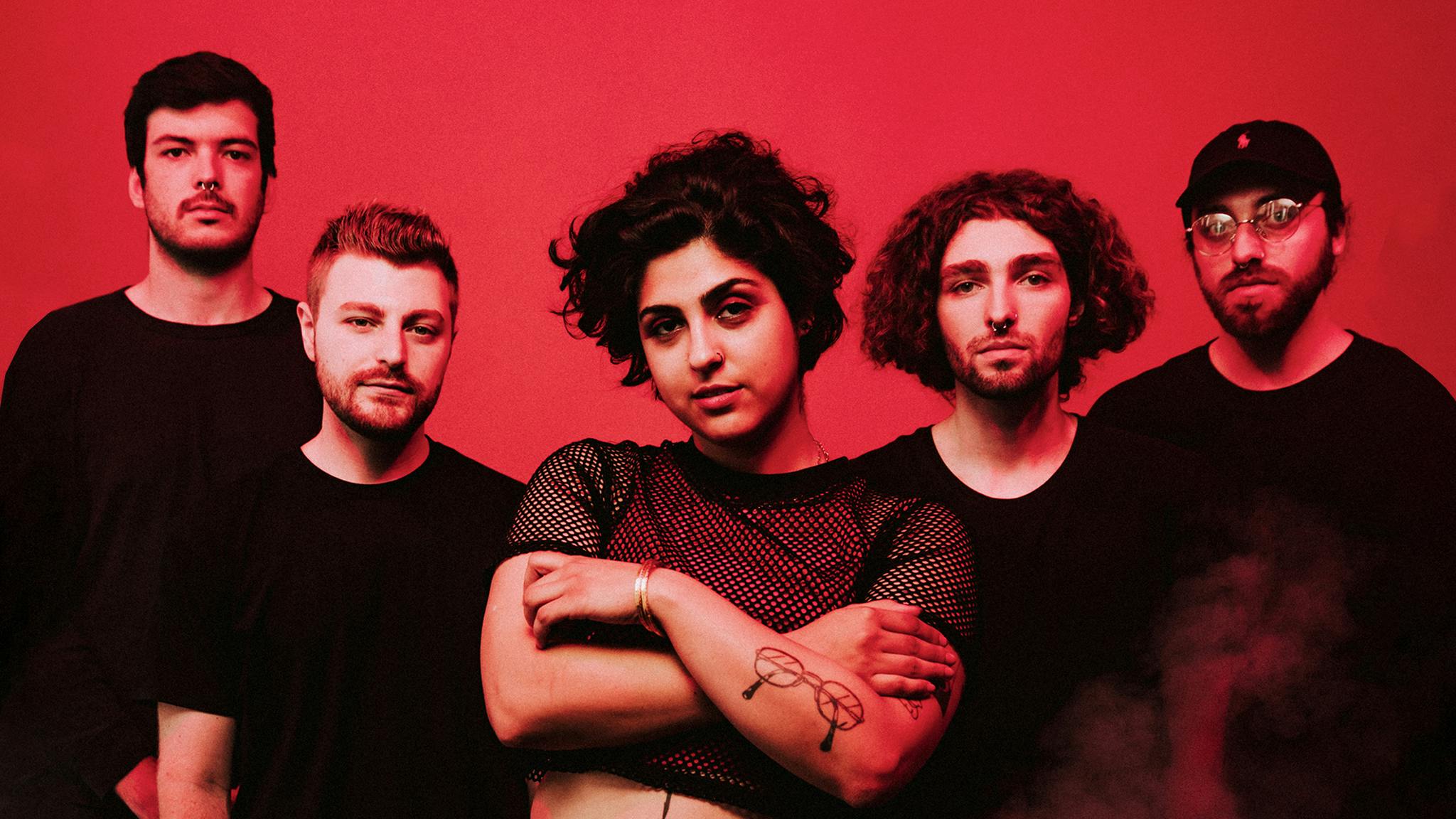
Sweet Pill document their way out of burnout and re-light their fire with a second record that epitomises hard truths and tough love.
Sweet Pill’s debut album made them emo’s hottest new stars. But after touring the world for three years, when the Philly fivesome came to make its follow-up, singer Zayna Youssef wasn’t finding her spark. She tells Kerrang! how she got here, and how through therapy and reflection she rekindled her fire even brighter to make Still There’s A Glow…
If you ask Zayna Youssef what fire means to her, she becomes totally animated. The Sweet Pill vocalist fumbles over herself, trying to properly express all of the correlations between its life cycle and the resistance and restructuring that she’s experienced recently.
“The first thing you think about is destruction, but fire is so many things,” she begins. “Fire is life. Whenever there’s fire, there’s usually a rebuilding process.”
Over the past few years, Zayna has had to confront parts of herself she’d been avoiding. She was – no pun intended – feeling burnt out and uninspired, and she wasn’t happy with who she was. And yet, admitting she was struggling with her mental health felt like pulling the pin on an explosive. Did she really want to go there? It was easier to keep saying she was fine.
But life couldn’t go on this way. Sweet Pill’s 2022 debut album Where The Heart Is soared to success, and they suddenly found themselves living inside a childhood dream. As they began work on their next record, though, Zayna just couldn’t connect with the music they were making. But with every lyric she scribbled down, scrapped and started over, she noticed one key theme kept cropping up: fire.
“When the boys were writing the bare bones of the songs, I was discovering what it feels to be angry that year,” she explains. “The album is about so many different aspects of the fire. There’s sparks, smoke, energy and it never really goes away unless you intentionally put it out.
“Ugh, I could ramble about this forever, man…”
It wasn’t just Zayna. Guitarists Jayce Williams and Sean McCall, bassist Ryan Cullen and drummer Chris Kearney were all facing their own hurdles, and collectively the band were all processing a lot behind the scenes.
Even just thinking back to the chaos that followed in the album’s wake, Zayna is still in disbelief, her eyes wide and dazzling. They rubbed shoulders with their heroes, ended up in Doja Cat’s Apple Music Replay, and trekked across the world playing the music they’d made as a university project. It was the stuff of fiction.
“Within months of it being out we were booked for our first full U.S. tour with La Dispute,” she continues, recounting as if still breathless. “It’s a blur because within the past four years we’ve been to the UK twice, we went to Australia, to Europe with Movements. We did so much stuff with bands that we grew up listening to.”
The schedule could be gruelling and Zayna would often lose her voice, but it was also wildly good.
“In the moment it’s like, ‘Yes, this is my job,’ then after I’d reminisce like, ‘I was just on the Zane Lowe show… And we’re an emo band!’”
So where could Sweet Pill possibly go from here? Their college years were now complete, they’d already excelled further than they had ever imagined with their music, and their second record needed to beat its revered predecessor. Trying to write, they scrapped a whole album’s worth of demos, thinking, ‘How do I write better than I did before with all this pressure?’
“That was the thing that I kept trying to get over. [With] every single step we were so insecure because we wanted it to be better than Where The Heart Is and it set the bar here,” Zayna says, raising her hand to the sky.
“The guys wrote really great music. What I had asked is that we just keep making more,” she continues. “It was hard for me to even bring that up, but we’re all so glad we did it because we wrote some of our favourite songs.”
Zayna now is probably the sort of person young Zayna would have dug. Long before she was the emo face of today, she got a bunk up into the plane of cool music in the early 2000s with a little help from her older brother.
“He was in a band. He was the coolest guy in my world,” she remembers. “Everything he did was just so sick! He took me – and he shouldn’t have, I was eight or nine years old – to a house show in the neighbourhood. It was the first time I saw people making out, the first time I heard loud music and people were moshing. I was like, ‘This rocks!’ He got me my first guitar when I was in third grade and showed me cool bands like Taking Back Sunday.”
Even if little Zayna never found herself at that formative show among snogging and circle-pits, she still would have made her way into singing. A brilliant music programme at her school allowed her to develop a love for the stage, and she sang in musicals like Hairspray, Grease and In The Heights. In tandem with her growing love of pop-punk, being a theatre kid had a lasting impact on Zayna, and she still utilises the skills and “weird little rules” of performing it gave her.
Theatre was the fuel that lit the fire, and emo led by confident storytellers was the oxygen for the rapidly growing blaze. Enter: Hayley Williams. The Paramore singer has even spoken of how much she loves Sweet Pill on her BBC podcast Everything Is Emo. As Zayna was finding her identity and growing into herself, Paramore were a vision of her dream future.
“I remember Hayley’s fashion was crazy! She wore whatever she wanted to. I remember buying a pair of yellow and red skinny jeans. People were like, ‘What are you wearing?!’ But I felt so cool.
“It’s unapologetically being yourself – that’s what she was showing people,” Zayna continues. “Being a confident person onstage starts a wildfire. With Sweet Pill I try my best to be as confident as I can, because I think some people need to see it in order to feel it themselves. I definitely saw it with Paramore and it made me feel like I could do anything.”
At this young age, Zayna also became conscious of the way women were treated differently by audiences. In her free time she’d watch old Paramore gigs on YouTube, and note some of the less pleasant comments.
“The internet has always been cruel,” she sighs. “People would just criticise because she has boobs. Sometimes when I’m onstage I think about that. But that’s what I’m talking about with confidence – that shouldn’t hold me back. Look at Hayley now, she didn’t stop.”
Zayna has been in therapy for about a year now, and through working on herself, this was something she recognised lay within her for some time.
“Being on a stage, open to criticism, open to people staring at you, it’s a different world that I didn’t really think about when we started this band. Of course we want people to listen and watch, but with it came a whole bunch of stresses I didn’t even realise.
“I [also] wasn’t taking care of myself. That’s what most of the album is about, needing help and thinking I was better than that,” she confesses. “It’s really hard for people to admit when something’s not going right. That’s what therapy helped me with: admitting there’s a reason shit’s been hitting the fan, because [I wasn’t] changing what [I was] doing. That’s why the album is called Still There’s A Glow. It’s a hopefulness. No matter what rock bottom you’re hitting, you can start a fire again.”
Still There’s A Glow is proof of Zayna’s self-discovery and continual healing. In Tough Love she admits, ‘I am scared, but not a coward / The difference is in the definition you give it,’ while finale Letting Go provides closure, as she sings of ‘burning the house I grew up in’. Perhaps the most on-the-nose is Rotten, a song where she takes ownership of shame, selfishness and being stubborn.
“The first part I came up with was the chorus where I say, ‘Circling around the words to make it seem less worse.’ It was a time where it was hard for me to admit things. I’m calling myself out for being rotten. I think there’s 100 people inside of us, there are so many versions of ourselves, and there’s bad stuff. This is me looking inside and saying, ‘I know you lie and I know that you are selfish. I see that you’re not a perfect person. Nobody is.’”
Zayna accepts that the glow still shows up in who she is now, both in an optimistic light that she looks to for drive and guidance, and as a haze when she feels less confident. Because Still There’s A Glow isn’t a happy ending, but a new start that’s self-aware and accepting of our flawed natures.
“I have a lot of imposter syndrome,” she admits. “After a show people will come up and speak to me about what the music means [to them] and my response is mostly, ‘That’s crazy that you listen to it!’”
She does understand, though.
“I was that kid, and I am this person still. Back then, on the day of a show I’d be in school and couldn’t wait for the day to end. At the gig, I’d look around and see people that I wanted to talk to, people that were themselves. I would go home and be upset that the show was over. That is something to live for. I live for it!”
Gigs were not only a haven for her self-expression, but connection and purpose – two things Zayna believes you’ll also find at a Sweet Pill show. You can even wear your most diabolical skinny jeans.
“My goal is to blur the line between the stage and the audience,” she smiles. “I love bringing people up onstage, making people who listen to Sweet Pill feel just as part of the band as we are.
“Sweet Pill is for everybody.”
Still There’s A Glow is released on March 13 via Hopeless. Sweet Pill play Download Festival in June – get your tickets now. This interview originally appeared in the spring 2026 print issue.
Read this next: