News

Kid Kapichi to embark on biggest-ever UK and European headline tour
Kid Kapichi have revealed an extensive 24-date UK and European headline tour, in which they’ll be performing “a mix from Fearless Nature and the classics…”
Announcing the departure of half their founding line-up last summer, the future seemed uncertain for Hastings punks Kid Kapichi. But as Jack Wilson and Eddie Lewis get set to strike back, they explain that darker, more intimate fourth album Fearless Nature is both a heartfelt farewell to their bandmates and the beginning of a bold new chapter…
Jack Wilson pulls no punches. Pulling pints, though? That’s a different matter entirely.
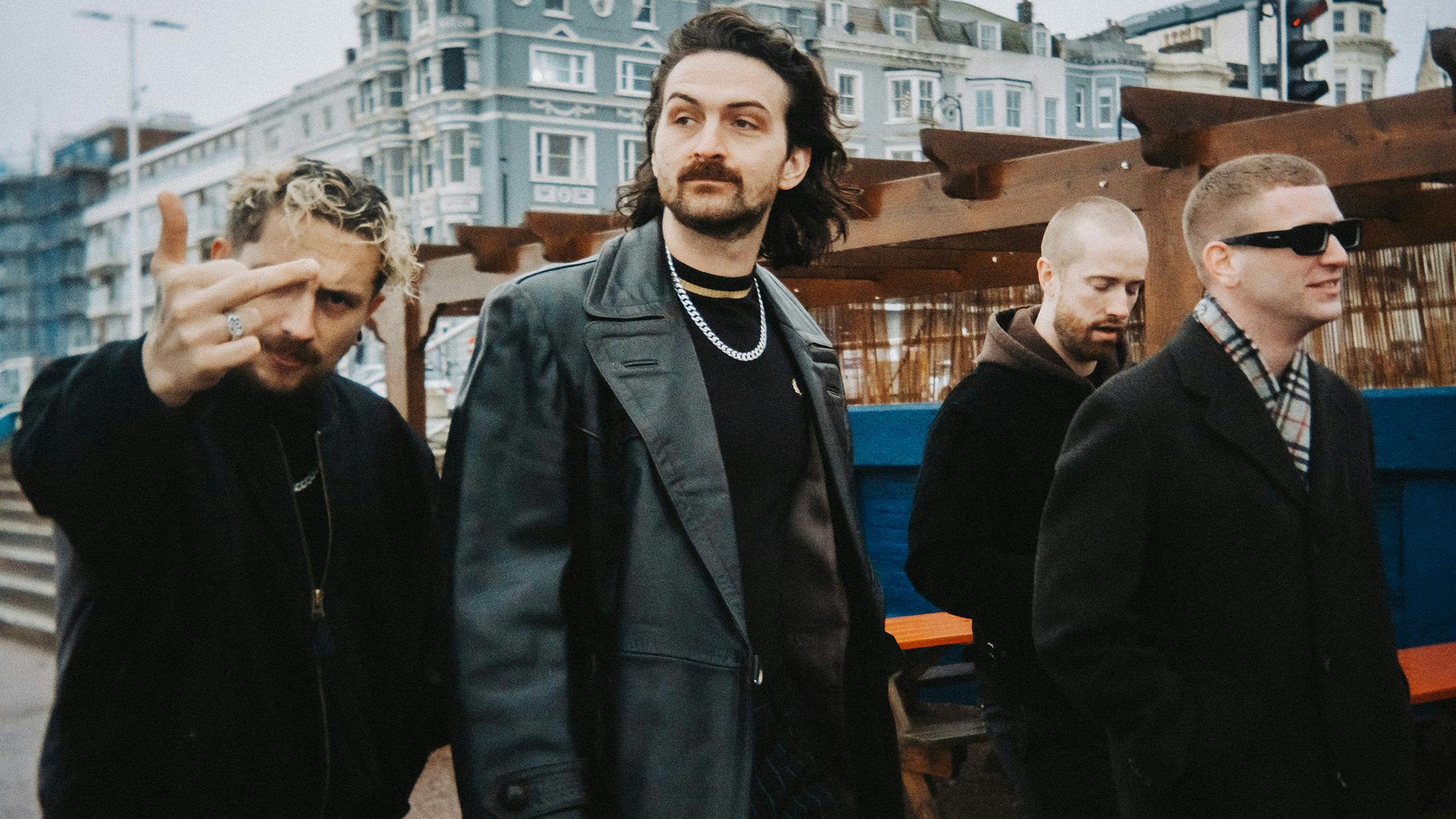
“People talk about the ‘struggling musician’ working behind a bar,” Kid Kapichi’s fiery frontman grins, welcoming us for a Kerrang! cover shoot to his erstwhile workplace at The Horse & Groom in St Leonards-on-Sea. “But you know what? We’ve actually been quite lucky, so I work here by choice!”
Commentators grappling with the modern men’s mental health crisis have no shortage of causes at which to point the blame, but the decline of traditional pub culture feels like a key culprit at times like these. Facing down struggles of his own in mid-2024 following the end of an eight-year relationship and cracks beginning to show that would lead to the departure of half his band, Jack wasn’t looking for answers at the bottom of a glass. But the chance for conversation, community and busy work to distract from the turmoil inside was pivotal to hauling himself out of the pit.
“There’s just not anywhere else for people to go, is there?” he ponders, underlining the importance of communal watering holes. “I needed something to do while I was really going through it last summer. My mate runs the H&G and was like, ‘Do you want to come work here, just a couple of shifts a week?’ I love the place and the interesting people who come here so now when I’m not on tour I just end up coming back. It’s funny because St Leonards – the Hove to Hastings’ Brighton – has become massively gentrified. It’s six quid a pint here, now. They built a four-million pound wellness centre right opposite this pub, but I always tell people we’re the real wellness centre!”
Kid Kapichi’s imminent fourth album Fearless Nature deals with much of the same sort of emotional processing. Crackling with festive cheer alongside bassist Eddie Lewis a couple of days before Christmas, Jack is on upbeat form this afternoon but there is no avoiding that this record’s gestation has coincided with the most turbulent 18 months of his life.
Trawling through every detail of the aforementioned romantic break-up isn’t relevant here. Nor, in truth, is a forensic dissection of why, after a decade together, guitarist Ben Beetham and drummer George Macdonald decided to leave the band. In short, those lads realised they weren’t giving it 100 per cent and it was unfair to hold back old friends who were. Although fans found out in May 2025, the decision had been made six months prior. “Touring takes a lot,” offers Jack. “You either love it or you fucking hate it. There is no in-between.” Eddie, meanwhile, stresses that both had shifted focus to interests away from slogging it out in a band: Ben getting stuck into his burgeoning career as a record producer while George wanted to explore on his own terms.
“He’s playing flute up a mountain in Nepal right now,” the bassist smiles, “which is so George…”
“Touring takes a lot. You either love it or you f*cking hate it”
More important is digging beneath the surface of the players left behind. Arriving all the way back on August 7, lead single Stainless Steel laid the groundwork for the full-length due to follow on January 16. Jack’s pulsating admission that ‘I’m not made of stainless steel / I’m made of blood, I’m made of bone!’ signified a need for self-analysis, while the oxymoronic question at that song’s heart would be emblematic of a broader conversation: ‘Are you scared of your fearless nature?’
“Fearless Nature is definitely more a question than a statement,” the frontman explains. “In summer 2024, I felt out of control for the first time in my whole life. I was scared. I was genuinely terrified at points. I don’t know why. But I remember being on the phone to friends telling them how fucking frightened I was, or walking up and down the seafront crying because I didn’t know what was going on. I felt quite lucky to reach the age I had without experiencing those feelings before, but it left me so ill-equipped to deal with being in a nosedive for which you feel responsible.
“The album could never have been anything else because that’s all that I was feeling. There were times that I was going in and writing and coming out not even remembering what I’d said or done. I was in such a state of confusion. When we finished recording it was almost like the first time I’d heard it. I listen back to it now and still hear things that feel like they were written by someone else – because they kind of were. Each song probes those feelings in a different way, asking a question I was asking myself a lot: ‘Are you in control of your brain, or is your brain in control of you?’”
Interrogating that quandary is an ongoing therapeutic process in which this record will be key. Still trying to understand what shook him to his foundations, Jack reckons that it was less about any of the individual changes than the surge of change itself after years of ostensibly stable ascendancy. Change is naturally inevitable, though, and it’s always better to harness its power than to fight it.
“That was the journey: trying to work it all out,” the frontman nods. “With Kid Kapichi, I came out of school and said, ‘This is what I’m gonna do!’ and I’ve spent every day of my life since doing it. Seeing the possibility that it could’ve been ending led to questions of, ‘What am I if for the last 10 or 15 years I’ve been the guy in a band?’ It’s something I’m still trying to work out. But it’s become less about trying to dig up some artefact to discover what was there all along than saying, ‘I’m leaving that period behind to discover what this next part of my life, this next person, is going to be.’”
“We’ve written an album that’s a little bit more sobbing and a little bit less robbing.”
Jack smiles at his punchy summation of Fearless Nature’s shift from the rabble-rousing Kid Kapichi of old to something much more introspective. Less than two years ago, this writer sat down with the band to discuss dynamite third album There Goes The Neighbourhood, which continued the kitchen-sink sociopolitical outrage perfected through 2021 debut This Time Next Year and 2022’s Here’s What You Could Have Won. Wearing their politics on their sleeve, songs like Zombie Nation and Can EU Hear Me? packed a punch, but much as they prophesied the 2024 election’s Labour landslide offering more problems than solutions, they knew a true paradigm shift was needed.
“Everything we’ve ever said politically stands,” Jack says. “I want to make that extremely clear. But for the first time in my life I started to realise that music didn’t resound with how I feel anymore. That doesn’t mean that we don’t still love that music. It doesn’t mean we don’t love those albums. It doesn’t mean we won’t continue to play those songs live. It’s that this band was never supposed to be about what just doing other people would enjoy. On HWYCHW it felt we’d locked onto something successful, then TGTN [became] about replicating it. That’s the one time when we weren’t as honest with ourselves as we could be. That’s not to say we didn’t like that album. But by the end of the cycle we were a bit sick of it all, which is why we’ve ended up where we are now.”
Leader Of The Free World, the mercurial first track on Fearless Nature, boldly blends the approaches. Yes, lyrics like, ‘It turns out the first one was better than the sequel!’ blatantly critique the return of Donald Trump, but Jack sees the song more as an “ode to madness” reimagining his own uneven mindset at the time via monologuing like the unhinged scribbling of a fanatic.
Hammering highlight Intervention cements the shift. Based on the experience of Jack “coming home one night – well, one morning – and [his] housemate and best mate waiting to sit down,” it opens into a compelling portrait of the pressure-cooker life on punk’s cutting-edge can become: ‘Too hot, too cold, reputation to uphold / Too weak, too bold, there’s a reputation to live up to.’ Elsewhere, the likes of Worst Kept Secret (‘Call me a weirdo you’re trying to mend, but don’t call me a friend’) and Head Right (‘If you’re gonna let me go, then let me go / If you’re gonna stick around, then let me know’) openly process the tangle of feelings he’s trying to unpick.
“As a band, we’d progressed musically, but lyrically we were talking about the same things as an inner-circle looking outwards,” Jack gestures. “Looking inwards was more difficult but truer, too.”
“For the first time in my life I started to realise that music didn’t resound with how I feel anymore”
Compared to There Goes The Neighbourhood, Fearless Nature feels like a new band. Instead, it’s a parting gift, written and recorded by the original four before Ben and George stepped away. Patience, for instance, was started before the split had even been discussed but spotlit the elephant in the room. “Ben and I were halfway through writing that before he said anything,” Jack remembers with a wry smile. “Now, I flash back to he and I sitting in a room singing those lyrics to each other – ‘I’ve got this feeling in my bones, something that says it’s time to go’ – and think, ‘Oh, fuck, yeah, obviously!’”
Having laid their cards on the table and with the knowledge that these would probably be the last songs they would help write as that quartet, Kapichi accelerated a strikingly shady stylistic shift.
“It opened up the door for things being different,” Eddie expands, highlighting that Ben was more involved in the production here than ever before, even teasing that the door is open for his return in that capacity down the line. “We’ve always had a formula where Ben and Jack would write together. Them working separately, as well as Jack and I writing more closely together, changed the dynamic, which led to songs and sounds coming out of the process which otherwise wouldn’t.”
“One thing that was really different was that where normally we would go into the studio demoed up to the eyeballs, just trying to polish up what was already done, here we were halfway through recording sessions deciding to do certain songs completely differently,” Jack adds. “Head Right got, er, flipped on its head. And Saviour ended up almost like an acoustic country song. We were just going with the flow, writing in the studio like the bloody Beatles. Musically, that felt so freeing.”
Although flashes of spiky jauntiness do peek through, Jack and Eddie like the description of these songs as the “softest, yet heaviest” to which Kid Kapichi have put their name. Historically, this band’s fuel has been anger, indignation and frustration, but the conversion to processing fear and uncertainty has led to a more of an atmospheric smoulder, less energetic but weighted with claustrophobic dread. Mid-album highlight Dark Days Are Coming feels especially emblematic: a beguilingly melodic nightmare lament for the world going to shit. Brilliant as tracks like that are, mind, they’re hardly custom-tooled for winding up and winning over festival fields. Jack shrugs. Throwing caution to the wind is integral to this record’s catharsis – then trusting fans to keep up.
“It’s unequivocally honest,” he asserts, looking into the unknown with real excitement. “I’m so proud of it in that sense. On the last album, we’d gotten to a point where we were still hoping that people would like the music we were making but already kind of knowing that they would. With this new music, I honestly have no idea what the response will be. I think some people will love it. I think some will hate it. At the end of the day, I don’t really care – because it’s so real to me.”
“Is ‘serendipitous’ the word?” Jack asks, unpacking exactly how Kid Kapichi 2.0 took shape.
“Yes,” nods Eddie. “Yes, it is.”
Having already turned to long-time drum-tech Miles Gill – a dab hand familiar with Kapichi’s kinks and quirks – to fill the gap left by George onstage, there was no obvious choice to replace Ben. But on crossing paths with old friend Lee Martin, it was clear that he had just the energy they sought.
“I was on a night out in Hastings and bumped into Lee,” Jack nods. “I hadn’t seen him for months, maybe even years, but he’s infectious to be around, one of the funniest guys I’ve met in my life. And he’s a great musician. It was a few weeks later that Ben told us he would be leaving and I called Eddie up to say that I already knew the guy to take his place!”
Officially, Jack and Eddie are the only full members of Kid Kapichi in 2026. There are a few reasons for that: making sure the vibe is right; presenting a “rebrand” without changing things too quickly or forcing anything down fans’ throats; dropping an album the new guys weren’t part of recording. Jack is keen to stress, however, that Lee and Miles are ‘full-time’ members currently acing a sort of probationary period and set to be integrated officially when they make their mark on album five.
“Without bad-mouthing Ben or George at all, the vibes now are like being in a brand-new band,” Jack continues. “There’s a whole new excitement. And because we went through most of 2025 doing underplays and things like that, it kind of felt like we were starting again. On our side, the handover couldn’t have been easier. Miles was asking things like, ‘Do you want me to play the live version or the one from the record?’ Lee had a few lessons with Ben to go over the material and have a look at his pedal-board – then he bought every pedal needed! I think that the fans already understand that they are ‘the band’ right now. They’re not going anywhere.”
Indeed, as they get back on the road, first for a series of album release shows in January, then festival slots at the likes of Bearded Theory, Y Not or All Points East (supporting twenty one pilots), with full-size headline shows still to be announced, fans will find the key elements in place. Energy. Honesty. The will to make the world a better place. And at heart, Kapichi are the same agitators they always were, with an improved grasp on mental health only sharpening focus elsewhere.
“Until you’ve dealt with the things inside yourself, it’s hard to engage with anything else – even what you’re going to haver for dinner, let alone how you’re going to improve the world,” Jack reckons. “The more well-adjusted we all are, the more CPU your brain has to focus on other things. I feel more engaged now, politically, than I did when I was shouting about those problems on record. We’re [political people] anyway, but we’re very fortunate to have the platform we have.
“And making an introspective album shouldn’t be seen as any kind of ideological backing-down. An album is a lot of words, but actions always speak louder. It’s like how when I was out recently and had this idiot saying, ‘You’re not wearing your badge today, are ya?’ Well, yeah, I don’t have 100 ‘Free Palestine’ badges for every item of clothing. It’s cold so I’m wearing a different coat!”
“I feel more engaged now, politically, than I did when I was shouting about those problems on record”
Closing out Fearless Nature, the 273 seconds of Rabbit Hole tie together all the threads and philosophies in a shimmering portrait of artists at a crossroads. Like a more bittersweet sequel to TGTN’s Tamagotchi, snapshots soaked in nostalgia of ‘a pub long closed, underage drinking with the family that we chose’ butt up against existential ruminations on ‘running out of time’ and the ultimate understanding that none of us are making it out alive, so we might as well enjoy the trip to the finish-line. Music has very much become therapy for Jack over the last few years but like traditional therapy, there is rarely a magic moment where you’ve realised you’re fixed. Instead, it’s a constant process of growth and evolution – the same as making music to capture the experience.
“Do I think this is the ‘most realised’ version of Kid Kapichi?” the singer ponders as we take our leave. “Absolutely not. This isn’t a moment we’ve been aiming for or some point we’ve expected to reach. Yes, this is exactly where I want to be at this moment in time. But the last album was exactly where I wanted to be at that moment. The same with the album before – and the one before that. All the best bands are never happy staying where they’re at, never settling for ‘who they are’ or ‘what they sound like’. I don’t want to compare Kid Kapichi to The Beatles, Arctic Monkeys or even Fontaines D.C., but great artists are always evolving. This isn’t a linear, mapped-out thing. There are a million different choices and we keep making new ones every day.”
“We don’t know where we’re headed,” Eddie signs off. “If we did, where would be the fun in that?”
Fearless Nature is released on January 16 via Spinefarm
Read this next: