News

Converge have just announced their second new album of the year
Following February’s incredible Love Is Not Enough, Converge will drop Hum Of Hurt in June: “To me, it leans more into being an emotional hardcore album…”
A new Converge album is nearly upon us, and as you’d imagine, it is excellent. Peeling back the layers of meaning behind Love Is Not Enough, legendary frontman Jacob Bannon talks striving for the best, the “beautiful soapbox” that is his band, and why it’s surprising that Foo Fighters are fans…
Love bites. It is that most complex and vast of all emotions. It can be everywhere and nowhere, seemingly without logic. It can unexpectedly sprout in times of war and strife and hardship, just as its absence can be its defining feature as times of plenty turn to decadence.
Love can mend your life, but it can also break your heart. As the drug you’ve been thinking of, it can render normal senses redundant, and make fools of us all. It can bring the tenderest, most selfless care for another, but exists as the bright side to hate’s shadow. It can act as both the reason to uproot one’s life and launch ship on the grandest of quests, or else shrink to the smallest of worlds, and a life of the barest simplicity. In all of these, love is all you need.
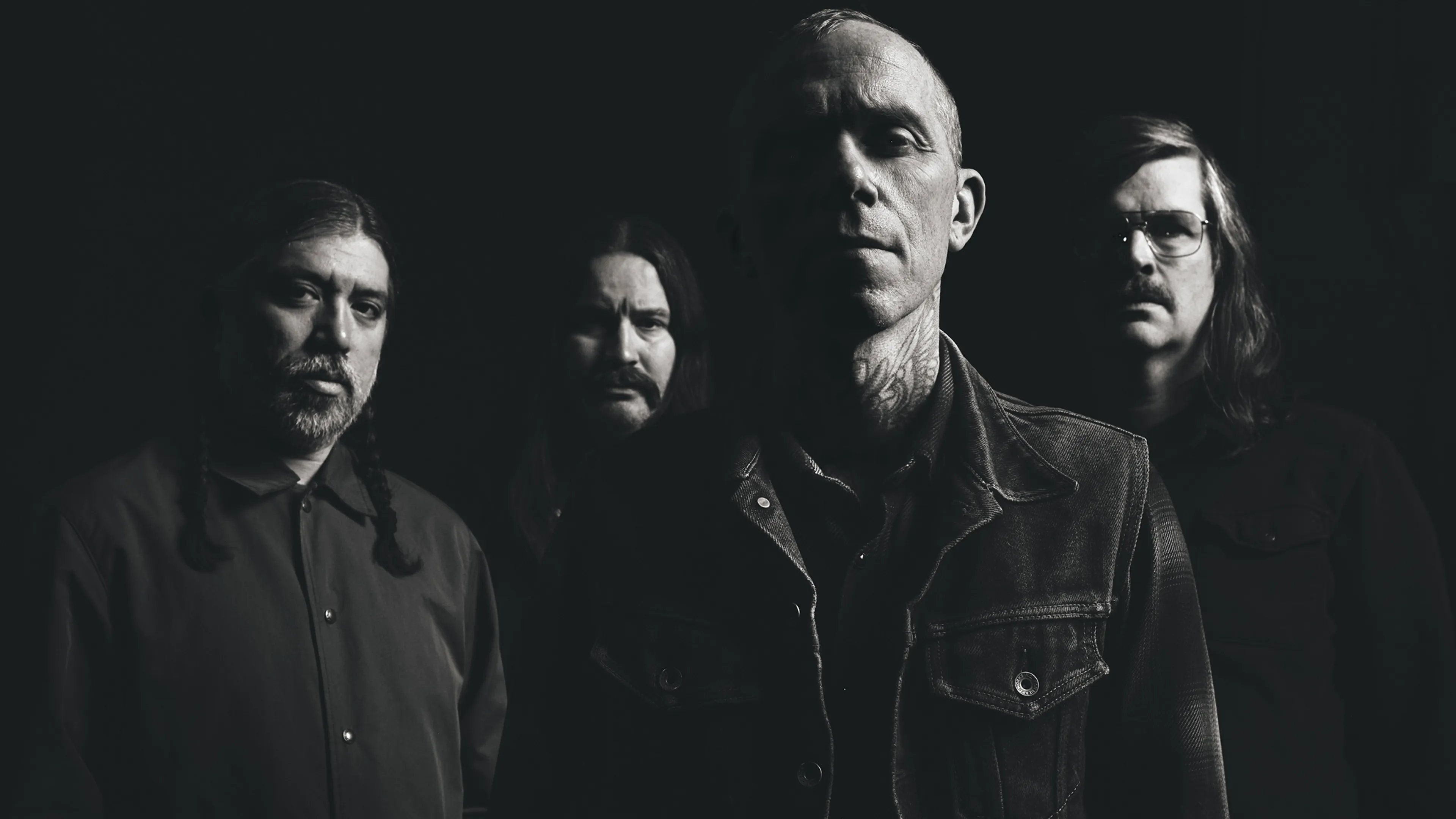
For Jacob Bannon, the reality of love is that it is not enough. It’s a phrase that came to him a while ago. As he and the rest of Converge ( guitarist Kurt Ballou, bassist Nate Newton and drummer Ben Koller) worked on new music for what would become their 11th album, it kept returning to him, connecting with much of what he was coming up with. Love, with all its joy and riddles, isn’t a vacuum. How it flows into the world, Jacob mused, and perhaps what it needs to inspire in its name, is just as important as the feeling on its own.
“Love isn’t enough,” he says. “You need action, you need dedication, you need empathy, you need compassion, you need anger. You need all these things. You need a gamut of emotions. But we need them all, and we need them all now.
“That title, it’s a statement about love being an essential thing, and a foundation for all the positives in life. But sometimes it also isn’t enough on its own to provoke action or provoke change. It’s not enough.”
So it was that Jacob found himself in a car, pen in hand, pouring himself into a notebook in the car park of a funeral home, capturing the words to what would eventually become the album’s climax, We Were Never The Same. Building on a simple riff that winds up sounding not a million miles away from the intense, in-the-moment jams of Songs For The Deaf-era Queens Of The Stone Age, it finds the singer navigating the storm of emotions that come at such a time, the sort of stark reflections that only truly present themselves when it’s too late. As they say, there is nothing like a funeral to bring the family together.
“That's a great example of an urgent time. No-one wants to be in that situation, right? You're feeling all the feelings, and I didn't really have words to say out loud about that. So I just returned to making something through writing, reflecting on that moment. I was just thinking: this is the only time that we come together to do these things and reflect on these experiences.
“It’s a wild thing to think about. We’re all put in these positions where we have all these things that pull us in a variety of directions within our lives – professional things, personal pursuits, relationships, family – and we get scattered. It's terrible that it takes tragedy or loss to be the thing that pulls us together in a way that feels warm.
“On that song, I’m exploring that idea of: Why are we showing up at these darkest times to celebrate something, but we don’t do it when we have the opportunity in front of us? It’s a very real question to ask.”
In a time where love seems the most needed thing, Converge are once again prescient. Though he reveals it was never intended as a grand concept, Jacob can point to the ways this theme subconsciously pops up over and over again.
“If you start to unpack something and look at it from a bigger perspective, I could apply that title, Love Is Not Enough, to all of these songs,” he says. “Love isn't enough to solve any of the issues that I'm exploring.”
Two words that he uses often in relation to his band’s music are “rawness” and “honesty”. When he writes lyrics, he tries as hard as possible to keep them as a genuine reflection. Describing the actual process, he calls it “torture”.
“I'm usually in a dark place, and I'm usually in a place where I feel compelled to write. I’ll need to do something with this energy that's in me that I cannot allow to just sit and exist without my reflection. When I have to have do it, I just sort of do it.”
This turbulence is also a marker of Jacob’s own articulacy. Not least in the fact that there is the emotional intelligence to gather together all-too-human parts of life as love and loss, but also its negative siblings anger and frustration. Jacob admits the realisations sadden him, but that he’s not judging. “If I am, I'm casting judgment on myself.”
And herein lies another point, why Converge have lasted so long, why their name is so respected, why Jacob is the man he is. It finds him “exploring those ideas and trying to hold myself a bit accountable for that in my own life. I always just try to be better.”
Love Is Not Enough is a brilliant album. All of Converge’s albums are brilliant. There’s a reason why, after three decades and change, the Salem-based quartet are venerated for being totems of credibility and incorruptible creativity and simply good music. As the record explodes and shrieks as it explores the bedrock and loose ends of heavy music – and when Jacob uses phrases like “hardcore” or “punk rock”, it’s a byword for attitude more than a redundant adherence to a rigid sound – as ever, it all has meaning.
Some of it is the most scalding and intense stuff you will encounter in 2026. Some of it uses the energy of its authors to turn the simplest two-note riff, into a cathartic, uplifting emotional vessel. Some is dark and pained, some is the clarity after a violent storm. At no point is it not alive with emotion and life in all its myriad complexities, as challenging as the storm of emotions that come from being human.
Fittingly, there's a preference for creative impulsiveness and spontaneity in the way they work, a counter to a lot of “modern heavy music being created on a grid, and you can hear the grid, and I can close my eyes and see the grid.
“Sometimes I want to hear a guitar slightly out of tune because the guitarist is just just pushing it that much harder. I want to hear things coming off the rails a little bit.”
Love Is Not Enough has more than enough of all this. Once again, the words of Kerrang!’s David McLaughlin when awarding full marks to 2017’s fabulous The Dusk In Us ring true: you don’t know how much you needed a new Converge album until you get a new Converge album.
Jacob is telling K! about all this from the headquarters of Deathwish Inc., the label he’s run for over 25 years now. It, like Converge, is an all-consuming labour of love. An artist by nature – and, as quickly becomes clear when you speak to him, one who treats what he does with what some might call seriousness, but respect might be a better word – the compulsion to express himself creatively is also driven by capturing, rather than perfecting something.
“I can get worked up about recording and getting things exact, but then I remember it’s punk rock. Our songs always develop a little over time as we play them live anyway, they’re never quite ‘finished’. As long as I got it down the way I intended, it's probably going to be fine.”
Currently, he hasn’t gotten enough distance from Love Is Not Enough to have a clear enough view of it to reflect fully. He doesn’t much listen back to his own music anyway. What is interesting him at the minute, though, and again, as an artist, is what other people are making of its themes.
“Everybody interprets it in a way that is specific to their own life. That's by design. The phrase can mean so much. It’s up to all of us to unpack and kind of figure out the meaning, if people even choose to do in the first place.
“And there's no incorrect interpretation. As long as people are trying to better themselves, trying to better the world around them, trying to leave it a better place than the one they came in, that’s good.”
Jacob keeps coming back to this idea, and the notion that one can always do more.
“Often something will happen to make you realise: I could have been more present in thing A, B or C,” he says at one point. “Then you start to ask yourself questions and try to take the lay of the land a little bit and, hopefully, see what changes you want to make in your own life that will bring some sort of positive, where you won't be put in the position to feel how you are in that moment again.
“It takes a lot of self-exploration, a lot of deep diving into yourself to go, ‘How can I do better?’”
“As long as people are trying to better themselves, trying to better the world around them, that’s good”
Even as he turns 47, with his entire adult life logged as the singer in Converge, this simple act of reflection and expression remains. It might not be the most enjoyable process, Jacob says, but writing is also a way of figuring out his feelings and the world around him. Always, though, it comes out as needed, rather than when he fancies it.
“If I have things going on in my life that I feel like I need to reflect on through art and music, that's kind of when I hunker down and [write lyrics]. I try not to force it. Because I just never really felt the need to. When I write, I write from a place where I internally feel the need to purge something, or get something out of me. So being creative is a good place to do that.”
This is partly what hooked Jacob when he first discovered hardcore as a kid. Back then, pre-internet, the underground didn’t just invite participation and hard work, but relied on it for anything to happen. As much as that, the creative space provided “something that would fill the roles that traditional family weren't filling for me”.
“When I found punk rock and hardcore and all that, the thing that stood out for me the most was that communal, kind of family environment that was there. We may have been dysfunctional, we may have had lots of weird offshoots and be far from perfect, but I really felt it, and found a connection.
“Even at a pretty young age, I chose to give myself to it, to the art form, to the community, to the power of the soapbox of heavy music. It was really exciting knowing we can get up there, and we can make all this racket, and we can take all of this damage and debris from our lives, and we can turn it into something that's beautiful art that helps others and helps ourselves ascend past those points.”
In the here and now, Jacob’s ideas of striving to do better are for something far more important than music and art. The example he sets isn’t just about a credible way to make and perform and support bands and scenes, but as a father of two.
“I think about my actions and my behaviours related to my children all the time. I’m far from perfect, and I try to improve on how I interact with them. I don't want to give them any residual pain, I don't want to traumatise them. I don't want to give them things which will be hurdles later in life. And it's not to say I won't or don't. I'm just trying to be a better person every day and be the best parent that I can be. It’s something that’s very real and present in my life every day.”
And in the context of all that, it throws focus on how Converge remain as they are, and as much of a feature in the singer’s life. Because life doesn’t stop until you die, and with that, there are always things that need exploration and expression and purging.
“I am grateful that I have this,” nods Jacob. “In some ways, I wish I didn't feel the need to have those things like playing shows and getting in touch with all those feelings and getting that catharsis. It would be quite interesting to live in a world where I just didn't feel the need to do that, or didn't have the psychological need to do that.
“But, you know,” he shrugs, “it is what it is.”
But Converge aren’t just what they are. It’s a rare band to last as long as they – since 1990, if you’re counting from the very first seed Jacob had for it, with the current line-up solid since their landmark 2001 album Jane Doe – and retain such a level of relevance and respect. Equally rare that a band of such vintage about to release their 11th album, should be doing so to such anticipation.
This is earned from having not an ounce of bullshit in their music, and from the equally honest churning and boiling of humanity within. And that comes from being an ever-sharpening blade, not getting distracted from doing what you want, how you want, the best you can. And the purity of being Converge is far greater than changing to fit in and belong. If that makes them outsiders, so be it.
“If I’m around metal people, I don’t feel like I fully relate,” Jacob admits. “If I’m around hardcore people, I don’t feel like I fully relate. If I’m around punk rock people, I don’t feel like I fully relate. I still very much feel like I’m on an island. In many ways, I think the four of us sort of identify our band as existing on an island a lot.”
Jacob is serious about all of this. Very, very serious. Not to a point of joylessness or being a pseud, but through a genuine and deep love (that word again) for what it is and what it means. Indeed, when discussing music, he smiles and lightens up far more when talking about Motörhead, or the way his point about songs naturally changing over time can be seen in Iron Maiden’s Live After Death, than when talking about his own band.
“I take it very seriously,” he agrees. “And I have a deep reverence for it as a thing, so I would be doing it a disservice if I didn't give myself fully to it the way I envisioned it as a kid. That that's the way I've always approached it. I've given it everything I have, because it's given me a platform, and it's given me a place to process and work through this stuff, and to come out the other end and see another day. I take that very seriously. It's not hyperbole. It's very, very real.
“It's not a calling, but it's my chosen art. This is what I chose to be the thing that is my vehicle. I'm not in it for a short duration of time, and I'm going to give everything I have to it.”
Pulling on this thread, he also wonders that it’s, at some level, a “selfish pursuit”. Selfish because the focus is “working through my own issues. I'm not working through somebody else's issues.”
Then again, he says, “I'm trying to get the doors open for everybody in it. If somebody could take something residual from what we do as a band, it would be that your voice is valid. Get in here, do your thing. This is your beautiful soapbox too, because it has room for so many.”
A lot of people have taken this away from Converge. Arguably, they are the most important and influential hardcore band of their lifetime. You almost want to tell Jacob to just take the damned compliment when he bats away the suggestion with a simple “we just do what we do, and we just want to be as honest as possible”. But the praise goes all the way to the likes of Metallica. At the Kerrang! Awards a few years ago, Dave Grohl picked up Foo Fighters’ gong for Best Live Band with the words, “Us? You know Converge are in this category as well, right?” Hearing this, there’s genuine confusion that a band as big as Foos would have any idea of his existence.
“I never reflect on things in that way. So although it's nice to hear, it also feels super-alien, too. Most musicians, we're all introverts in some way, right? We're all kind of socially a little weird and awkward, so I don't hear those things. I also just don't think our band is very well liked like that, personally. But that's a me thing, right?”
How do you mean?
“That comes down to my insecurity as a person and what kind of value I perceive myself having as a person in this world. I just don't think of what we do in any light like that.
“I kind of live in a vacuum and try to exist in one. I feel like if I have a lot of outside forces influencing things that I'm a part of, they would become disingenuous in some way. I try to hunker down and do the thing that I feel motivated to do. It’s cool to hear something like Foo Fighters like us, but if people are telling me things like that every day, I have too low of a self-esteem to actually hear it.”
“I don’t think our band is very well liked like that, personally. But that’s a me thing, right?”
Again, you want to tell him to take the compliment, but you imagine it wouldn’t be a very Jacob Bannon thing to do so. And anyway, perhaps the biggest compliment isn’t so much who it’s coming from, but what someone gets from his music. Because that’s the bit he’s given his whole life to.
“Whatever they take, I just want it to be a positive. I want them to take all this explosiveness, all this aggression and intensity, and channel and absorb it in a way that doesn't propel more negativity in the world.
“I hope it helps them get to the next day. Just like it helps me.”
Love Is Not Enough is released February 13 via Deathwish / Epitaph
Read this next: